Summertime brings a host of joyful outdoor activities and events but it also brings the warmth and moisture that Japanese beetles & bagworms thrive in. Along with the emerald ash borer, these are some of the most damaging pests for the beautiful lawn, trees and landscape you’ve built and cared for! At Ryan Lawn & Tree, we’re always on the lookout for anything that can destroy your sacred outdoor living space — whether you’re in Tulsa, St. Louis, Wichita, Kansas City or Springfield — so we’re offering this quick rundown on these common summer plant and tree pests and how to control them!
Japanese Beetles
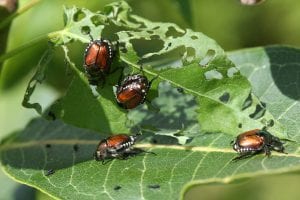
Japanese Beetles are one of the most destructive garden pests a plant lover can face. First arriving from Japan about 100 years ago, these pests feed on more than 300 species of plants, ranging from roses to poison ivy. They are particularly destructive to linden trees, fruit trees, crepe myrtles and many flowering and vegetable plants.
How to get rid of Japanese beetles
Our plant care Pros at Ryan Lawn & Tree are scouting and Inspecting for these nasty beetles every time he/she visits your property, but the beetles could be actively feeding on your plants between visits. If you have special plants that you don’t want to see get destroyed or if you’ve had a history of Japanese beetles feeding on your property you’ll want to be on the lookout as well and call for the insect and pest control services from a reputable company like Ryan Lawn & Tree. You can also sign up to get on a preventative suppression program.
A Pyrethrin-based insecticide is a safe and effective way to control Japanese beetles on flowers, roses, trees and shrubs. In addition to controlling Japanese beetles, it also controls other types of beetles and pests. It’s also possible and advisable to hand-pick the beetles off smaller plants and shrubs if you have only a few beetles each day.
While applying grub control as part of Ryan Lawn & Tree’s Signature Lawn Care program, either separately or in combination with summer fertilizer application, will protect the lawn throughout the season against the damage grubs can do in the lawn, it does NOT protect your plants from the voracious Japanese beetle. These beetles will fly long distances to find your yummy trees, rose bushes and other plants.
RYAN Pros also do not recommend popular Japanese beetle traps. The pheromones used in these traps draw way more beetles to your trees than the trap can capture. So in a sense, you are drawing more beetles to your beloved plants….like a shining lighthouse telling all the neighborhood beetles where your treasured trees are.
Life-cycle of a Japanese beetle
Japanese Beetles start as white grubs about 5-6″ below the surface and move nearer the surface as spring arrives. In late June, the grub turns into a pupa, maturing into its flying beetle form and then begins feeding on landscape plants. Females live for a few weeks feeding on trees, shrubs and roses in the morning, returning to the lawn in the afternoon to lay more eggs. Within the first 48 hours of feeding, the females will lay 40-60 eggs just below the soil’s surface. Once laid, the eggs will hatch within two weeks and the process will begin for the next season.
What does a Japanese beetle look like?
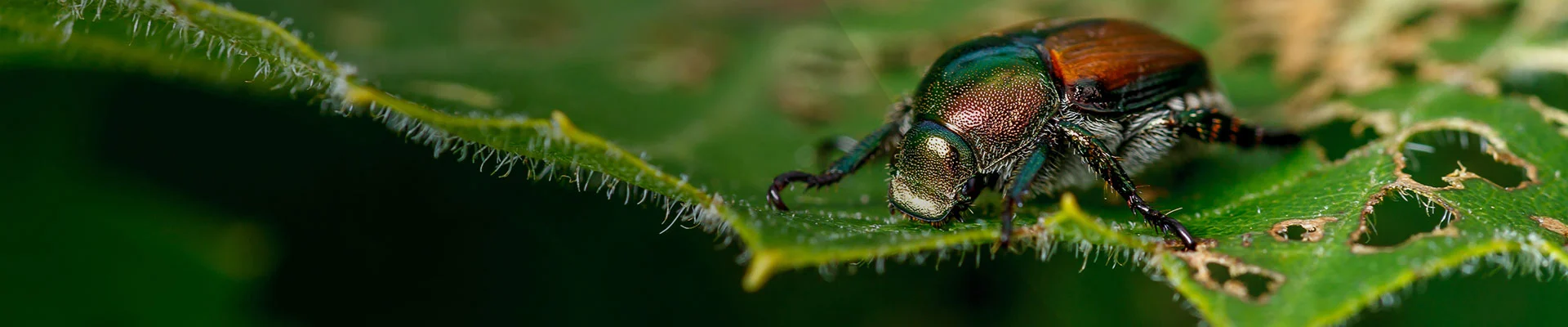
The adult Japanese beetle is about 1/3” to ½” long and has a shiny, metallic-green body and bronze-colored elytra (wing covers). The beetle has six tufts of white hair under the edges of its wings. Japanese beetles produce one generation each year and can burrow up to 12 inches below soil in the winter to survive. Japanese beetle larvae, or white grubs, have a brown head and grayish-black rear end.
What damage do Japanese beetles cause?
Japanese beetle is one insect that can wreak havoc on your lawn and garden at both life stages! In their grub stage, Japanese beetles can chew the roots of your grass inducing dormancy or causing lawn death. But mammals like raccoons, skunks and moles digging for grubs in your lawn are so much worse than the grub damage alone. The mammals destroy the surface of your lawn, requiring much more physical labor to get your lawn-area/surface even ready to be reseeded.
When mature beetles emerge from the ground in late spring to midsummer, they often fly in from nearby areas and target stressed plants. Beautiful garden roses and other beetle favorites are soon left with skeleton-like leaves and blossoms.
How to get rid of Japanese beetles
Our plant care Pros at Ryan Lawn & Tree are on the lookout for these pests and will notify you when they are spotted. You will want to consider the insect and pest control services from a reputable company like Ryan Lawn & Tree. A Pyrethrin-based insecticide is a safe and effective way to control Japanese beetles on vegetables, grapes, raspberries, flowers, roses, trees and shrubs. In addition to controlling Japanese beetles, it also controls other types of beetles and pests. It’s also possible and advisable to handpick the beetles off your plants.
While applying grub control as part of Ryan Lawn & Tree’s Signature Lawn Care program, either separately or in combination with summer fertilizer application, will protect the lawn throughout the season against the damage grubs can do in the lawn, it does NOT protect your plants from the voracious Japanese beetle. These beetles will fly long distances to find your yummy trees, rose bushes and other plants.
RYAN Pros also do not recommend popular Japanese beetle traps. The pheromones used in these traps draw way more beetles to your trees than the trap can capture. So in a sense, you are drawing more beetles to your beloved plants….like a shining lighthouse telling all the neighborhood beetles where your treasured trees are.
[Have a Japanese Beetle Problem?
Get a FREE Estimate From Your RYAN Pro Today!]
Bagworms
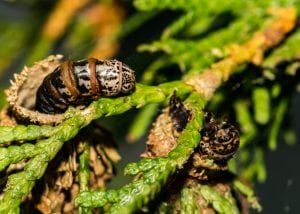
You may only think of bagworms as those long, thin, brown sacks they create of silk in the fall and you see hanging from your favorite evergreen. However, this seemingly innocent silk holds up to 1000 eggs which hatch in the late spring or early summer and then feed on your beautiful green branches. At Ryan Lawn & Tree’s Midwest locations, the most common targets for bagworms are eastern red cedar, junipers, and arborvitae. Bagworms also sometimes damage pines, spruce, bald cypress, maple, box elder, sycamore, willow, black locust, oaks and roses. Thus, the need for bagworm control.
Life-cycle of a bagworm
The life cycle of a bagworm has four stages — the egg, larvae, pupal and adult.
-
- Bagworm Eggs — The overwintered eggs (in the year-old female bags) begin to hatch in late April or early May.
- Bagworm Larvae — Young larvae (caterpillars) begin to feed and construct bags immediately. As the larvae grow, they add to the bag until it’s at it’s full size — around 2” long. They use the silk to fasten the bag to a tree step.
- Bagworm Pupal — In August, pupation occurs inside the bag.
- Bagworm Adult — In late August and September, the adult males emerge as bagworm moths and search for wingless females still inside their bags for mating. After mating, the female lays several hundred white eggs inside her old pupal case, drops from the bag and dies.
What does a bagworm look like?
-
- Bag — The 2” brown, cocoon-shaped bag is the most visible evidence of bagworm infestation but once hatched, the bagworm makes several transformations. The “bag” of the bagworm is created from their silk and pieces of tree and then eventually filled with eggs.
- Larvae — Larvae emerge as tiny black dots about the size of a pinhead, and light as a feather. These caterpillars can use their silk to “fly” to other trees and build new homes. Once full-grown, the 1” long larvae have a dark brown abdomen and the head and thorax are white, spotted with black.
- Adults — The adults are small moths with clear 1” wings and a black, hairy body. Male bagworms are ashy-black. Adult female’s body is soft, yellowish-white, and practically naked except for a circle of woolly hairs at the posterior end of the abdomen. They are wingless and have no functional legs, eyes or antennae.
What damage do bagworms cause?
Bagworms prefer evergreens, like juniper, arborvitae, cedar and spruce, but will attack more than 128 different types of trees and evergreens. Bagworms in their larvae stage do most of the damage as the caterpillars feed on buds, needles and plant material while creating their bags causing branch tips to turn brown and then die. In heavy infestations, bagworms may eat more than 80 percent of the tree, killing an entire evergreen. On deciduous trees (those that lose their leaves in winter), bagworms chew small holes in the leaves that can cause defoliation. These trees may survive, but in a weakened state that leaves them more susceptible to the emerald ash borer and diseases.
How to get rid of bagworms
The easiest way to get rid of bagworms is to cut off the bags by hand and destroy them. Lift branches, clip off bagworm egg sacks and drop them into the bucket of water with dish soap, making sure they are submerged fully. Dump the soaked bagworms into a sealed plastic bag and throw them in your trash. Repeat this procedure every fall, winter and early spring to reduce bagworm populations before the eggs hatch. If this process doesn’t appeal to you, or your bagworm population is overwhelming, turn to your certified arborists at Ryan Lawn & Tree for help!
[Have a Bagwork Problem?
Get a FREE Estimate From A RYAN Pro Today!]
Need a Hand With Bagworm or Japanese Beetle Control?
We hope this has given you some ideas on what methods are used to control Japanese beetles and bagworms. We have a FREE guide for emerald ash borers, too! If you need help saving your evergreens, trees or landscape plants from the damage caused by Japanese beetles, bagworms, or other pests, reach out to the certified arborists and professional plant care experts at Ryan Lawn & Tree. We’re happy to examine your plants, identify the problem, and recommend the best treatment plan to help! Call our specialists at 855.216.2293 or request an estimate online. We look forward to serving you soon!